Shopify pricing: how much is Shopify a month?
Our team of experts and researchers rigorously test and evaluate website builders through transparent, in-depth testing procedures and methods using both in-house and industry-approved tools.
Drawing on cybersecurity insights, we provide unbiased, empirical rankings and analysis to help users make informed digital platform choices.
Learn more

Shopify is one of the leading platforms for building and managing eCommerce stores. We covered its features, website builder, and other powerful eCommerce tools in our Shopify review. However, Shopify’s pricing is a difficult topic to cover in one paragraph and deserves its own review. The overall subscription costs depend a lot on the plan, terms, and additional features and tools you might want to include.
Here’s what I will cover in this Shopify pricing review:
- Plans and pricing, including different subscription terms
- Pros and cons of each plan
- Clear use case guidelines on which plan suits which businesses best, based on monthly revenue
- Billing-related terms such as free trials, money-back guarantees, hidden fees, refund policies, and so on.
Whether you’re opening your first online shop or scaling an established store, you’ll find practical insights here to help you choose the plan that fits your needs and budget best.
The pricing in this guide includes exclusive Cybernews discounts, helping you get Shopify plans at lower introductory rates. Additionally, prices are listed in US dollars, so they might be different in other currencies and markets.
Shopify website builder pricing 2026: overview
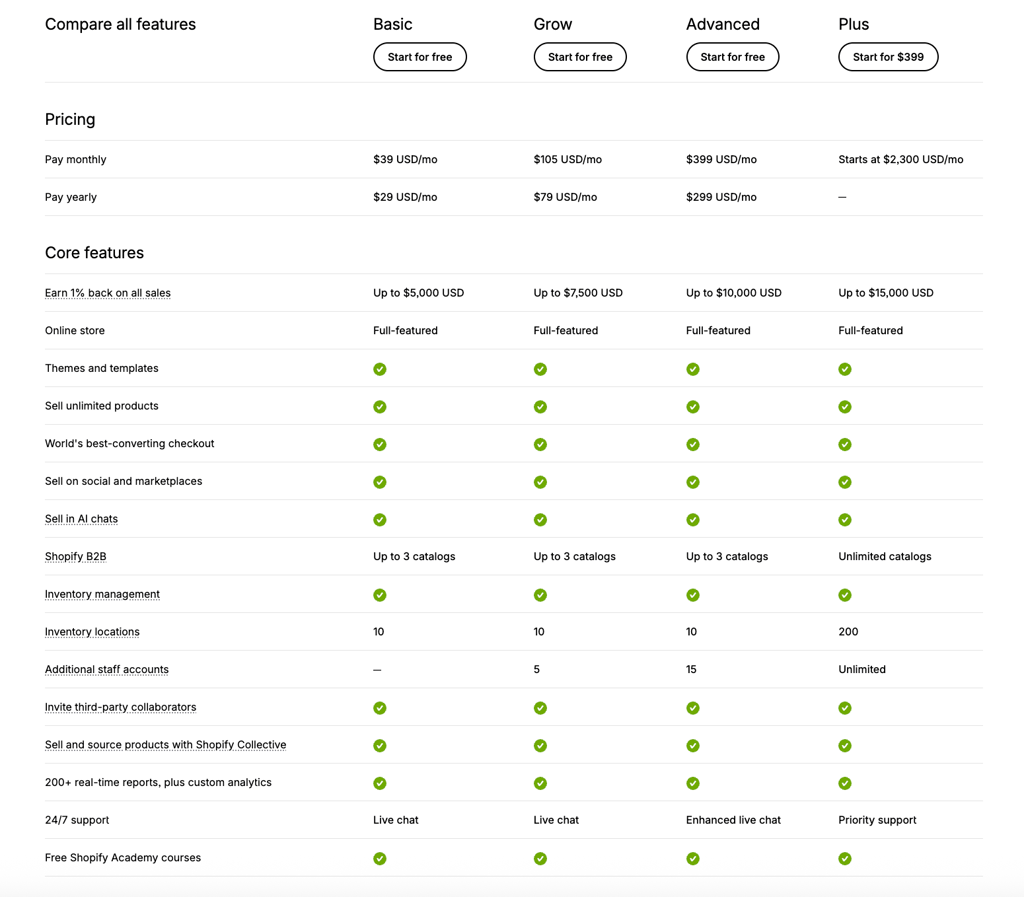
Shopify offers 4 website builder plans for eCommerce businesses. They are available for either a monthly or an annual subscription:
- Basic plan – $39.00/month, $39.00/month if you pay yearly.
- Grow plan – $105.00/month, $105/month if you pay yearly.
- Advanced plan – $399.00/month, $399/month if you pay yearly.
- Plus plan – starts at $2,300/month
Shopify offers a 3-day free trial for the Basic, Grow, and Advanced plans, then $1.00/month for 3 months. There’s also an introductory offer for the Plus plan, starting at $399.00. The 3-day free trial lets you experience the plan and the web builder platform in full – and decide whether you want to go forward with your subscription or not. In this sense, it is in place of the industry-standard 30-day money-back guarantee.
The overview below covers the Shopify website builder, as the main product of the provider. If you are interested in other Shopify product pricing, go ahead to that section.
How much does Shopify cost a month?
Shopify has three main plans with either monthly or annual subscriptions and offerings that fit different levels of online stores. Below, I break down each plan, including its pricing, features, and best use cases.
Shopify Basic plan: pricing starts at $39.00/month
Shopify Basic plan is a good option for basic online stores, or if you’re just starting out with eCommerce and selling goods or services online. Generally, the Basic plan should be enough for businesses with under $50k in revenue.
- Monthly price: $39.00/month
- Annual price: $39.00/month ($348.00 for a year)
- Trial: 3-day free trial, then $1.00/month for 3 months
- Money-back guarantee: no-refund policy, use the 3-day trial instead
Key Basic plan features include:
- A full-featured online store that includes themes and templates, sales for unlimited products, the option to sell on social media and marketplaces, as well as inventory management features (with 10 inventory locations) and tools for in-person sales.
- AI features such as a website builder with millions of tokens and an AI assistant for eCommerce-related help.
- Up to 3 B2B catalogs, and an option to set up a separate B2B-only store.
- Invite third-party collaborators with limited access to the store. On the other hand, the Basic plan doesn’t include any staff accounts, which means only the owner of the store can access and manage the Shopify website. While this may be a workaround for the staff account limits, businesses with bigger teams might be too limited by third-party accounts.
- Integrations with thousands of apps, but limited checkout customization and limited Shopify API access for custom apps.
- Localization features, including localized domains, storefront translation, and local payment methods (available with Shopify payments)
Shopify Grow plan: pricing starts at $105/month
Shopify Grow plan is a good option for eCommerce businesses earning 50k to $200k per month, or teams that need multiple full-access staff accounts for the online store. In general, the main difference between the Basic and the Grow plan is the addition of staff accounts and lower credit card rates and reduced fees on payments made outside of Shopify Payments, which are lower. If you select to use PayPal, for example, with any of the plans, a transaction fee will be applied in addition to any subscription fees you already pay.
- Monthly price: $105.00/month
- Annual price: $105/month ($948 for a year)
- Trial: 3-day free trial, then $1.00/month for 3 months
- Money-back guarantee: no-refund policy, use the 3-day trial instead
Key Grow plan features include everything in the Basic plan, plus some useful additions:
- Five staff accounts, in addition to the third-party collaborator accounts with limited access.
- Lower transaction fees than with the Basic plan, from 2.5%–3.5%, plus $0.10–$0.49 per online sale and a 1% fee for third-party payment providers.
- Full API data access for building custom apps with the Shopify API.
- Third-party calculated shipping rates are available as an add-on. This feature is useful because the shipping rates are calculated in real-time based on destination, package weight, and dimensions rather than applying a fixed shipping rate. Plus, you can connect your existing accounts with any shipping providers, applying your own negotiated shipping rates.
Shopify Advanced plan: pricing starts at $399/month
The Shopify Advanced plan is an upgrade from the Grow plan for businesses with monthly revenue from $200k to $800k. Additional staff accounts, increased API rate limits, and the option to use your own business accounts with third-party shipping companies rather than relying on Shopify’s own are suited for stores handling complex commercial operations day to day. That said, even the advanced plan lacks some essential features for online merchants, such as combined listings – these might only be available via third-party applications and plugins.
- Monthly price: $399.00/month
- Annual price: $399/month ($3,588 for a year)
- Trial: 3-day free trial, then $1.00/month for 3 months
- Money-back guarantee: no-refund policy, use the 3-day trial instead
The Shopify Advanced plan includes everything in the Grow plan, plus some additional features:
- 15 staff accounts, in addition to third-party collaborator accounts with limited access.
- Third-party calculated shipping rates are included by default.
- Lower transaction and third-party payment fees, ranging from 2.4%–3.5%, with an additional $0.10–$0.49 per online sale and only a 0.6% fee for third-party payment providers.
- Select APIs’ rate limits are twice as high as those for the Basic and Grow plans. This allows you to build stronger Shopify automations and apps, suitable for larger online stores with more store data.
- Enhanced live chat support, helping you reach a human support agent quicker
Shopify Plus plan: pricing starts at $2,300/month
The Shopify Plus plan is miles away from the other three plans, both in terms of pricing and in terms of the features it offers. This plan is for eCommerce businesses with monthly revenue above $1M, or those that require very specific features, such as high-traffic checkouts, ad optimization, combined listings, new-feature testing environments, and more.
- Monthly price: $2,300/month
- Annual price: not applicable
- Trial: starts at $399.00 for the first month
- Money-back guarantee: no-refund policy, use the 1-month discounted trial for $399.00 instead
As the most advanced of the four Shopify eCommerce plans, Plus includes numerous features that are not available with any other subscription. They are quite substantive, which also perhaps explains the hefty price tag.
- Everything in Advanced, plus unlimited B2B catalogs, 200 inventory locations, unlimited staff accounts, priority support, 20 advanced POS Pro locations (200 if you use Shopify Payments), competitive transaction fee rates, 10 times the standard API rate limit, and 25 headless storefronts for a faster shopping experience.
- High volume checkout that can handle up to 40k transactions per minute, perfect for intense sales periods such as Black Friday.
- Combined listings, which let you combine multiple versions of the same item into one product listing.
- Ad optimization with Shopify Audiences, which offers a cheaper way to reach high-intent audiences.
- Bot protection, especially useful during high sales periods, such as flash sales and Black Friday.
- Testing environment for new features and store personalization with custom functions.
- User groups with assigned roles should make managing your online store easier.
Shopify's free trial and money-back guarantee
Notably, Shopify offers flat-rate pricing, which means there are no price hikes upon renewal. The reason for this is the 3-day free trial, and 3 months for $1.00/month after that, applicable to all annual plans. That’s right, you can try any Shopify plan for free for 3 days, no card or other payment details required, only a sign-up with email. In that time, you can build a full draft store: pick and customize a theme, add products and collections, set up shipping and taxes, connect a payment provider, and test apps and key features before you decide on a plan.
The Plus plan does not have a 3-day trial. However, you can try the subscription with all of the Plus features for $399.00 for one month, which is a big discount from the usual $2,300/month price.
Because of the 3-day trial and the Plus plan’s first-month discount, Shopify doesn’t offer a money-back guarantee for its subscriptions. You can get a refund if your specific situation requires it, but in that case, you will need to contact Shopify’s support team.
Other Shopify products and pricing
Beyond the core plans, Shopify offers a range of add‑on services for domains, marketing, in‑person sales, and more. You can add these on top of your active Shopify subscription for additional fees to boost your existing plan or better align it with your needs. Here are some of the main ones:
- Shopify Domains. Custom domain registration (e.g., .com, .store) with free WHOIS privacy, auto‑configured DNS, SSL, and unlimited email forwarding. Pricing typically starts around $10.00–$20.00/year.
- Shopify Email. Built‑in email marketing tool for sending campaigns directly from your admin. Each plan includes 2,500 free emails/month, with additional emails costing about $1.00 per 1,000.
- Shopify POS Pro. Advanced point‑of‑sale features for brick‑and‑mortar and pop‑up stores (inventory, staff permissions, omnichannel selling). Priced at $89.00/month per location on top of your plan.
- Premium themes. Professionally designed, feature‑rich store themes from the Shopify Theme Store. One‑time purchase, typically $150.00–$350.00 per theme.
- Shopify Apps. Thousands of third‑party apps for marketing, reviews, upsells, inventory, and more. Many are free, but paid apps commonly range from $10.00–$100.00/month each, with some specialized tools costing more.
Does Shopify have hidden fees?
Technically, Shopify doesn’t hide any fees. However, it can be hard to estimate total costs if you use services that are available to use with your subscriptions, but cost extra, such as a tax platform. You can also end up paying extra if you want to buy third-party apps from the Shopify app store.
Third-party apps
The Shopify app store offers thousands of different applications from third-party developers. The pricing for these applications is also set by the developers, and the billing will come from them, not Shopify. However, some apps in the Shopify App Store are also free, and others offer free trials or have free versions.
Non-Shopify payment methods
Shopify payment gateways are included with all plans and don’t cost extra. However, if you choose to use other payment methods, you will be charged extra. These extra fees include both Shopify’s transaction fees, as well as any fees from the third-party payment gateway provider.
Shopify Tax
Shopify Tax is a proprietary tax calculation platform that calculates taxes for all your products and services according to the newest, updated tax rules. The pricing for this service depends on your location and sales volume per year. Here’s how the pricing system works:
| Sales volume | Shopify Tax price |
| First $100,000 (or other currencies) per year in global sales | Free |
| >$100,000 (or other currencies) per year in global sales |
|
The above pricing terms apply only to stores with a yearly global sales volume below $1M. Additionally, the fees are capped at $5000 per calendar year (also in other currencies).
How to get Shopify cheaper?
Shopify is one of the most expensive eCommerce website builders, with prices starting at $29.00/month. But what if I told you there’s a way to get it cheaper?
Firstly, despite being so expensive, Shopify offers quite a good free trial + introductory pricing deal: for the first 3 days, you can try it for free, and the three months after that will cost you only $1.00/month.
Additionally, you can always look out for Shopify deals on Black Friday and Cyber Monday. And if you don’t want to wait for the festive discount seasons, I recommend you check out Shopify coupons. Maybe a great discount is hiding in there unseen.
Shopify's refund policy
Shopify has a strict no-refund policy as stated in their Terms of Service. This applies to all plans and services, irrespective of cancellations or deactivations. This means that in the case of canceling your subscription before the end of the subscription period, deactivating your store, downgrading your plan, or any other issues, such as misspelled domains, you will not get a refund. This also includes unused services.
However, Shopify may grant you a refund if there was a billing error. In such cases, you should contact support and have all the receipts, that is, the necessary documentation and proof of error, ready. That said, it’s good to keep in mind that refunds for apps bought in the Shopify app store are handled by the respective app developers.
Shopify's payment methods
Shopify Payments is a feature included with all plans that lets you set up payment methods that power checkout on your online store. The available methods are:
- Credit and debit cards
- Shop Pay
- PayPal
- Apple Pay
- Google Pay
- Local payment methods
- Buy now, pay later options
- Manual payment methods
Additionally, Shopify has quite a few payment methods for paying for your own subscription and other bills:
- Credit and debit cards
- PayPal
- Shopify Balance
- ACH debit (in the US)
- SEPA direct debit (for stores based in Denmark, Finland, Germany, the Netherlands, or Switzerland, and only in Euro)
Unfortunately, you can’t use payment methods like Google Pay or Apple Pay to pay for your own Shopify subscription or services.
Keep in mind that available payment methods may vary depending on your location. For example, in Brazil, you can only use international Visa and Mastercard cards. I recommend checking out the Shopify help center page for payment methods to find out about which payment methods are available to you.




Our in-house research team and expert writers work hand in hand to regularly test website builders and provide accurate and fact-checked information. Discover the ins and outs of how we test and evaluate website builders.
Recent Updates
FAQ
How much does a Shopify website cost?
A simple Shopify eCommerce website with the Basic plan can cost you up to $1000 per month. While the Basic plan subscription starts at $39.00/month with an annual plan, transaction fees, and certain features such as POS Pro, email, and messaging automations, tax platform, and other addons can significantly increase the overall website price.
How much does Shopify cost per month?
Shopify offers tiered monthly subscription plans to fit different business sizes and stages. The main plans for online stores include the Basic plan, which starts at $39.00/month with annual billing or $39.00/month with monthly billing. The Grow plan is $105/month annually or $105.00/month monthly, and the Advanced plan is $399/month annually or $399.00/month monthly. For large enterprises, the Shopify Plus plan starts at $2,300/month.
Is Shopify free to start?
Yes, Shopify has a 3-day free trial for all plans, so you can get started for free. After the free trial ends, the first three months of the subscription will cost you only $1.00/month.
What is the cheapest Shopify plan?
The cheapest Shopify plan that includes a full-featured online store and many other marketing, shipping, and analytics features is the Basic plan, which starts at $39.00/month. There is also a $5.00/month Starter plan, but it does not include an online store and is better suited for selling on social media.
Does Shopify take a percentage of sales?
Shopify only applies a credit card processing and transaction fee, the percentage of which differs depending on your plan. Shopify doesn’t take other percentages of your sales.
What is included in each Shopify plan?
Each Shopify plan comes equipped with a full-featured online store. This includes a website builder, unlimited hosting with free SSLs, unlimited products, a full-featured marketing suite, some shipping options and discounts, Shopify Payments, up to 100,000 emails for free, and features for selling internationally, such as currency conversion and translation services.
Can I upgrade or downgrade Shopify anytime?
Yes, you can upgrade or downgrade your Shopify plan anytime. However, the new subscription will only take effect after the current billing cycle is over. This means that if you pay annually, your plan will renew with the new subscription only after the year is over.